

Real-time MIDI control
Real-time MIDI control
Adaptive chord control.
Adaptive chord control.
Apply inversions and voicings to the chords you play in real time, with MIDI-mappable performance controls and independent chord and bass sequencing.
Apply inversions and voicings to the chords you play in real time, with MIDI-mappable performance controls and independent chord and bass sequencing.
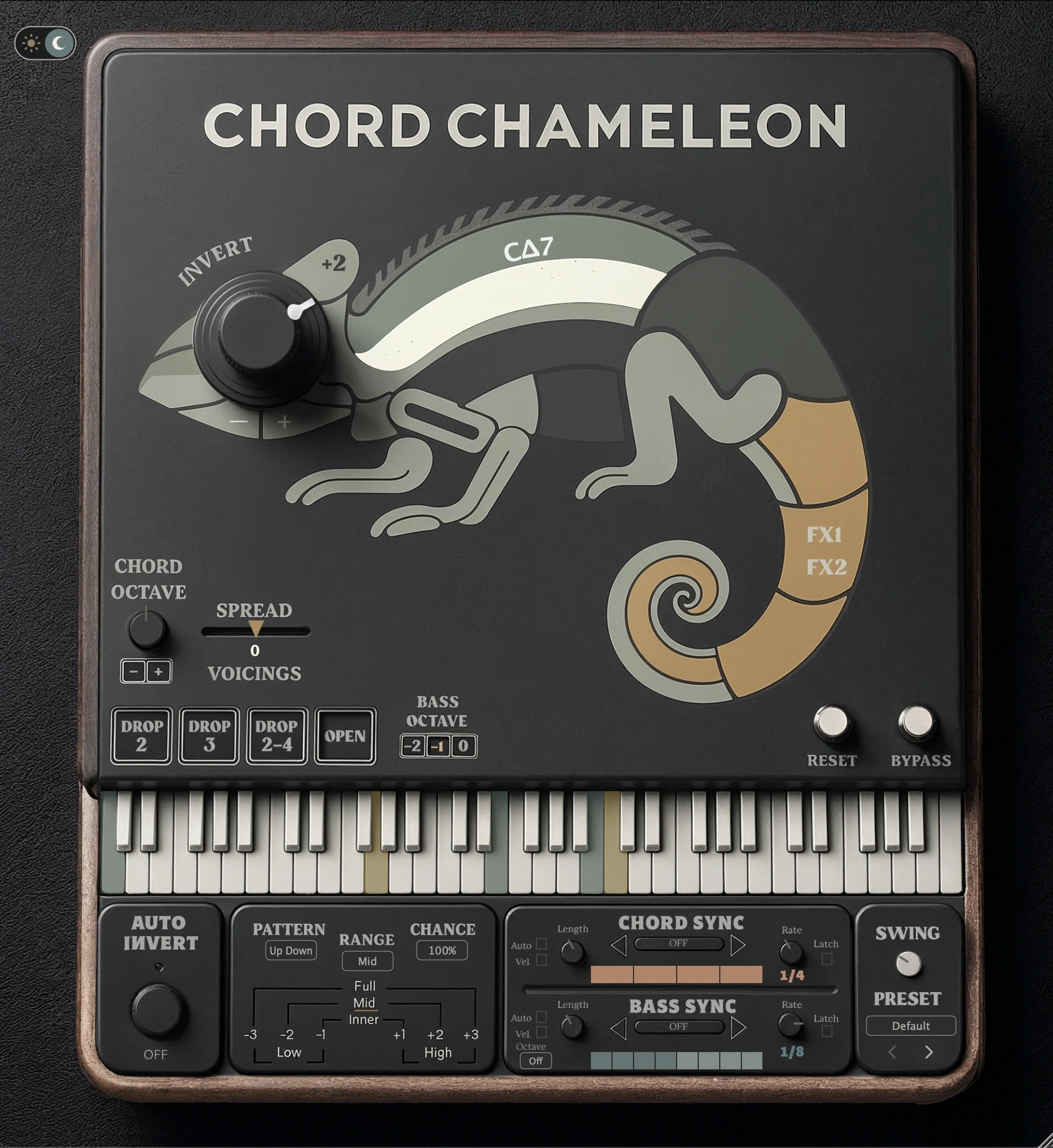
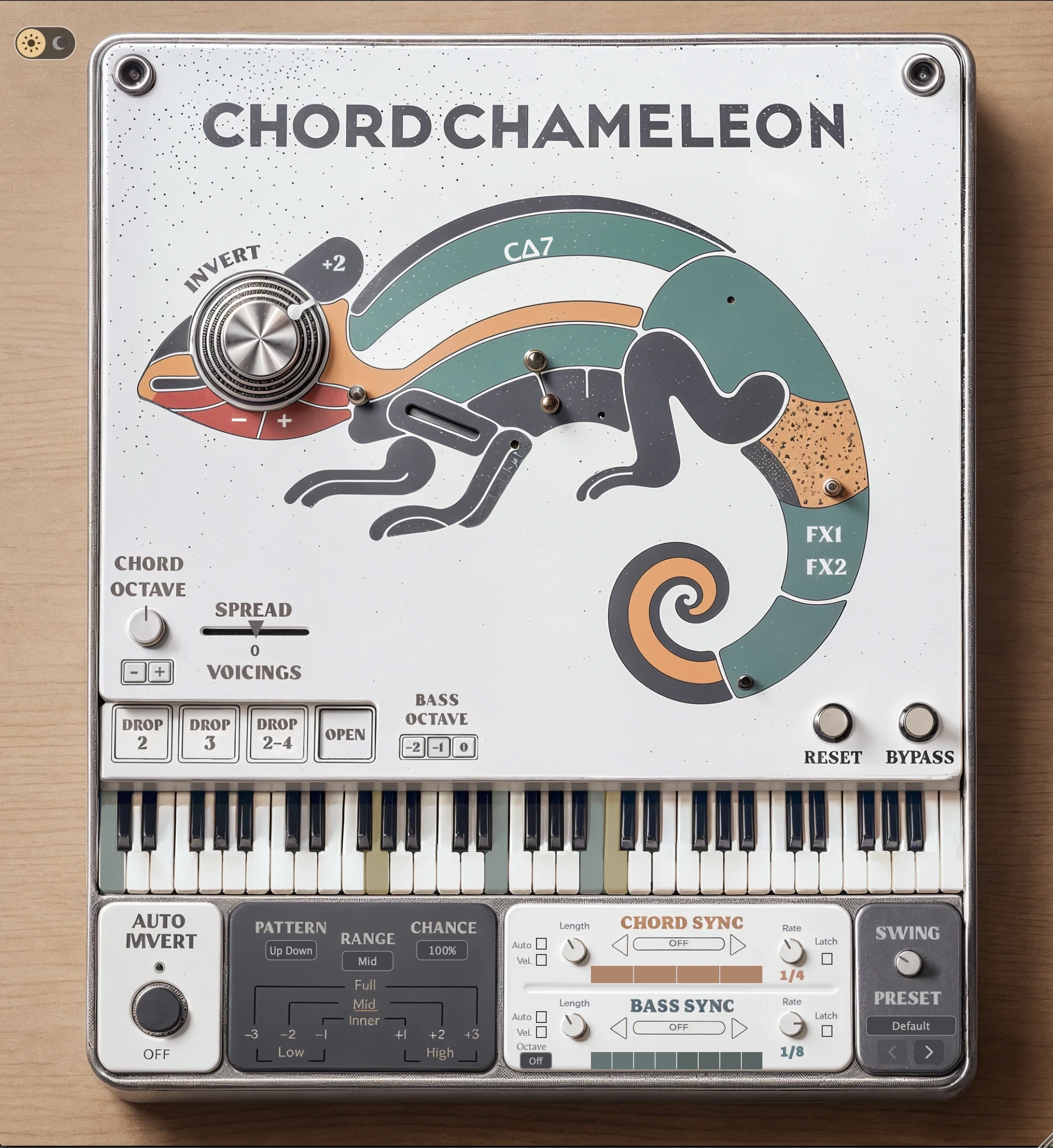
HOW IT ADAPTS
Built around the way you play.
A struck chord takes one path. Notes played one at a time take another.
Two ways to play. Two distinct responses.
Two ways to play. Two distinct responses.
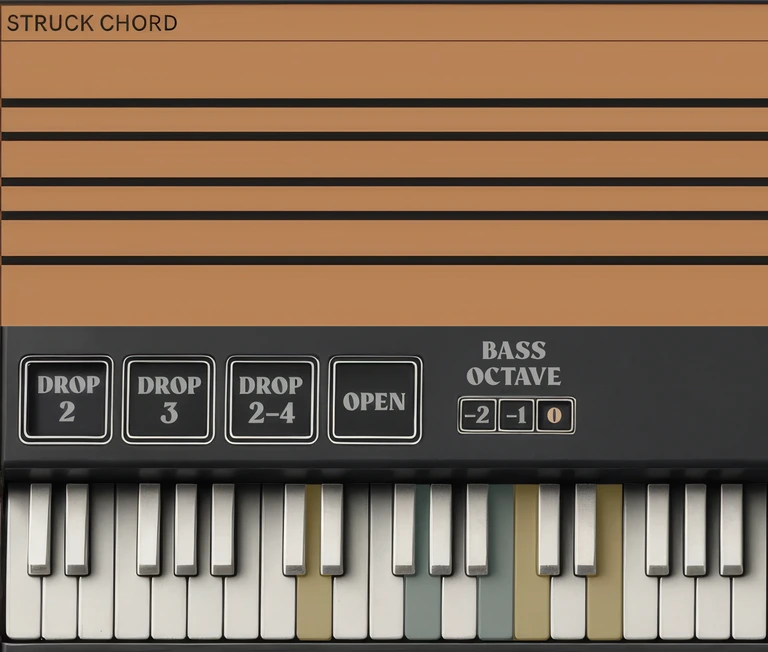
PATH A · STRUCK CHORD
Strike a chord to reshape it.
Chord Chameleon applies the selected inversion and voicing when you strike three or more chord notes together.
Chord reshaped
PATH A · STRUCK CHORD
Strike a chord to reshape it.
Chord Chameleon applies the selected inversion and voicing when you strike three or more chord notes together.
Chord reshaped
PATH B · ROLLED NOTES
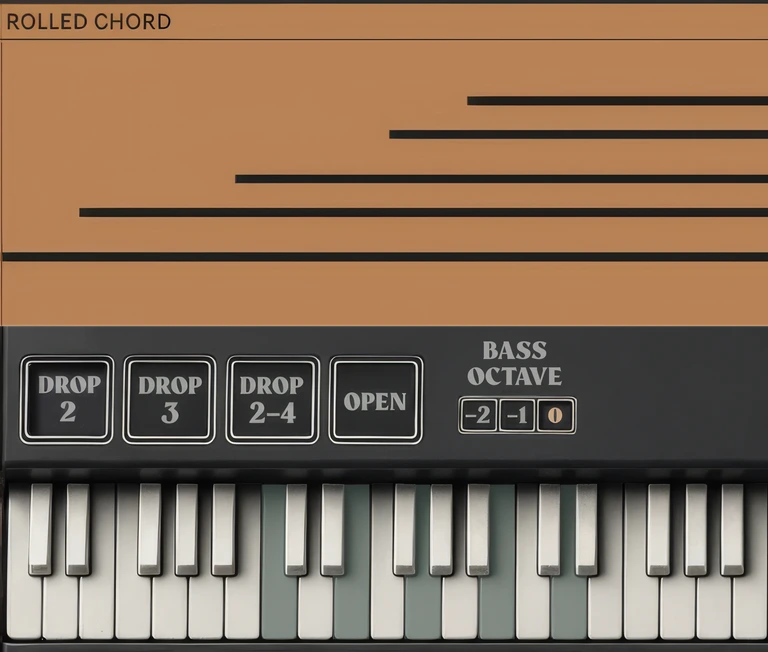
Roll notes one by one. They stay as played.
Play and hold the notes one at a time. Chord Chameleon leaves their pitches as played.
Notes stay as played
PATH B · ROLLED NOTES
Roll notes one by one. They stay as played.
Play and hold the notes one at a time. Chord Chameleon leaves their pitches as played.
Notes stay as played
PATH A CONTINUES · WHILE HELD
Hold the struck chord, and nearby notes follow it.
While any note from a struck chord is still held, nearby follow-up notes use its current inversion and voicing.
Follow-up notes
01 · STRUCK CHORD
02 · NEARBY FOLLOW-UP NOTE
03 · ALL CHORD NOTES RELEASED
G
E
D
C
Chord Chameleon applies the selected inversion and voicing.
A nearby note follows the held chord’s inversion and voicing.
The connection ends when you release all notes from the detected chord.
PATH A CONTINUES · WHILE HELD
Hold the struck chord, and nearby notes follow it.
While any note from a struck chord is still held, nearby follow-up notes use its current inversion and voicing.
Follow-up notes
01
02
03
G
E
D
C
01 · Three or more notes are struck together. The chord is detected and processed.
02 · One chord note is still held. A nearby follow‑up note takes the chord’s current inversion and voicing.
03 · When every note from that chord is released, the connection ends.
OVERVIEW
Key Features
Use the chord controls and sequencers together or separately, with live input or existing MIDI clips.
OVERVIEW
Key Features
Use the chord controls and sequencers together or separately, with live input or existing MIDI clips.
Key Features · 01 / 03
01
01
Inversions & Voicings
Combine inversions and voicings to rearrange chord notes as you play.
Key Features · 01 / 03
01
Inversions & Voicings
Combine inversions and voicings to rearrange chord notes as you play.

Use familiar chord shapes
Hear the same chord in different positions without changing your fingering.
Prepare the next inversion
Choose an inversion while holding a chord. The change takes effect when you play the next one.
Keep the bass and melody intact
Inversions and voicings leave bass and melody notes outside the chord unchanged.
Use familiar chord shapes
Hear the same chord in different positions without changing your fingering.
Prepare the next inversion
Choose an inversion while holding a chord. The change takes effect when you play the next one.
Keep the bass and melody intact
Inversions and voicings leave bass and melody notes outside the chord unchanged.
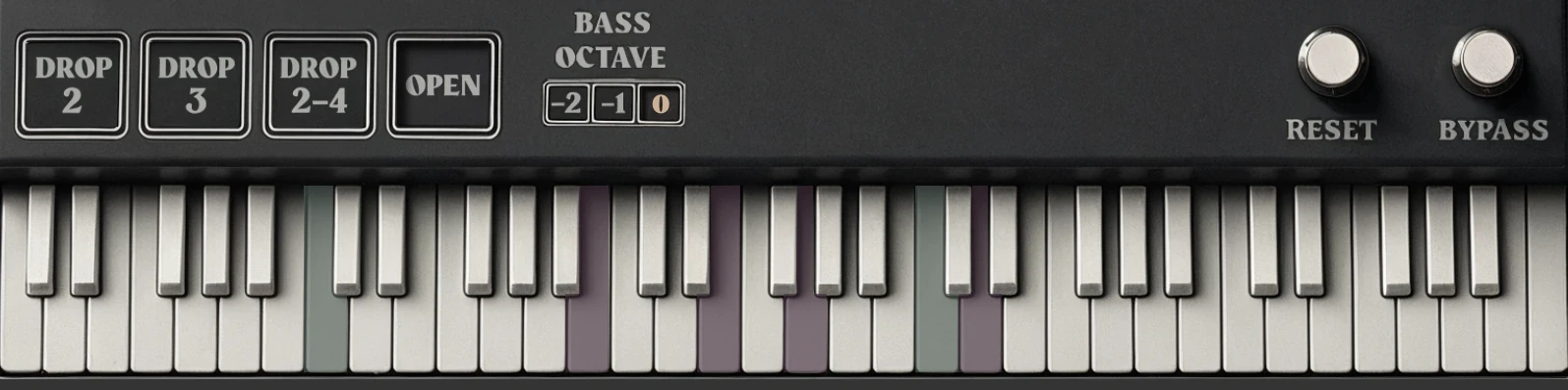
Bass note stays in place
Chord Octave and Bass Octave set the two registers separately.
Bass note stays in place
Chord Octave and Bass Octave set the two registers separately.
Four voicing presets
Voicings rearrange the spacing and order of notes within a chord.
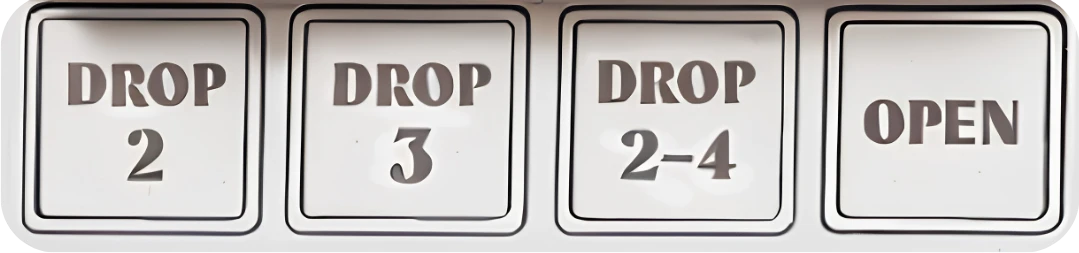
Drop 2
Lowers the second-highest chord note by one octave.
Drop 3
Lowers the third-highest chord note by one octave.
Drop 2-4
Lowers the second- and fourth-highest chord notes by one octave.
Open
Lowers the highest and fourth-highest chord notes by one octave.
01 · CHORD SPACING
01 · CHORD SPACING
Key Features · 01 / 03
Cluster & Spread Voicings
01 · CHORD SPACING
Key Features · 01 / 03
Cluster & Spread Voicings
Compare chord spacing
Cluster the notes.
Keep their spacing.
Widen the chord spacing.
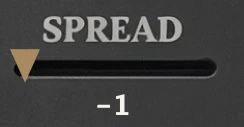
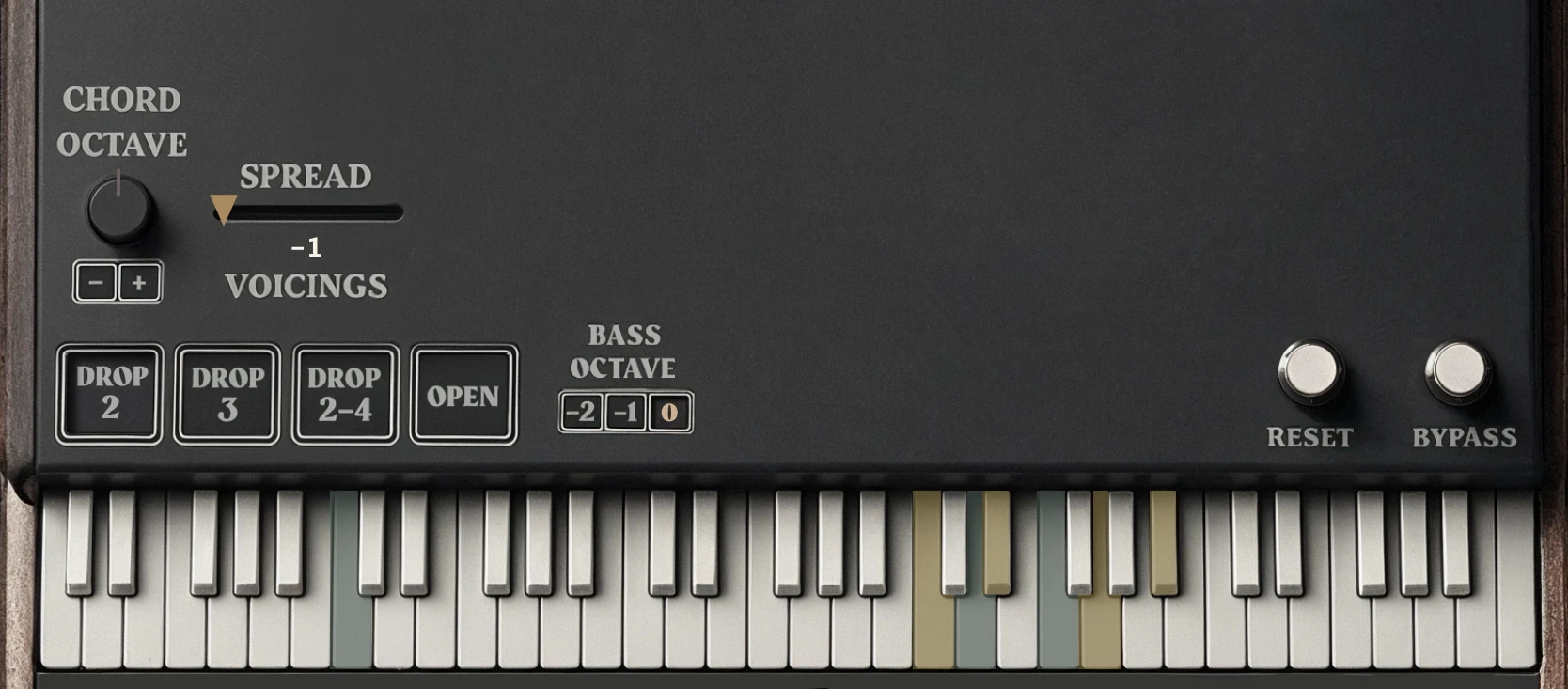
The same chord appears with tighter or wider note spacing.
Compare chord spacing
Cluster the notes.
Keep their spacing.
Widen the chord spacing.
The same chord appears with tighter or wider note spacing.
−1
−1
Cluster
Cluster
Brings the chord notes closer together.
−1
Cluster
Brings the chord notes closer together.
0
0
No Spread
No Spread
Makes no additional change to chord spacing.
0
No Spread
Makes no additional change to chord spacing.
+1
+1
Spread
Spread
Widens the spacing between chord notes.
+1
Spread
Widens the spacing between chord notes.
AUTO INVERT
AUTO INVERT
Key Features · 02 / 03
02
02
Auto Invert
Auto Invert
Vary the inversions in a progression automatically.
Auto Invert prepares changes as you release a chord, ready for the next one you play.
AUTO INVERT
Key Features · 02 / 03
02
Auto Invert
Vary the inversions in a progression automatically.
Auto Invert prepares changes as you release a chord, ready for the next one you play.
Auto Invert in use
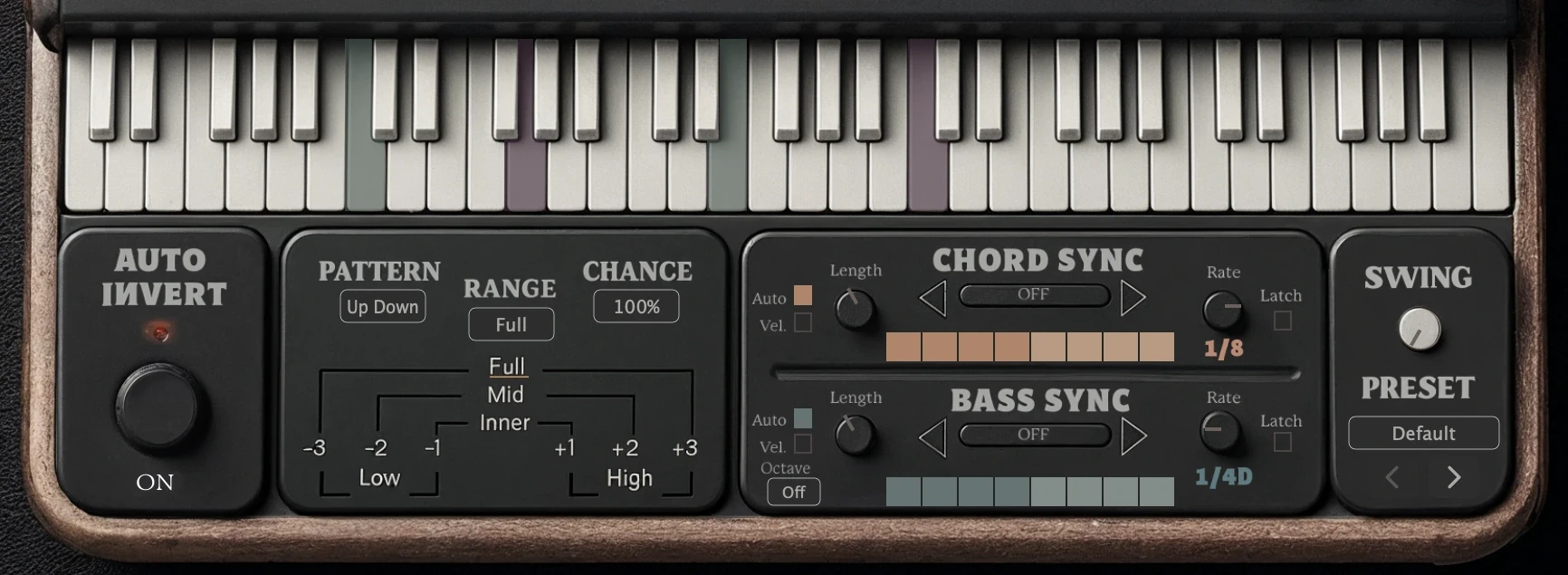
Auto Invert changes the chord inversion while preserving bass notes.
Auto Invert changes the chord inversion while preserving bass notes.
01
01
Pattern
Pattern
Inversion order
Up, Down, and Up Down follow a direction. Random Neighbor and Random make the inversion sequence less predictable.
01
Pattern
Inversion order
Up, Down, and Up Down follow a direction. Random Neighbor and Random make the inversion sequence less predictable.
02
Range
Available inversions
Choose a narrower or wider inversion range, or restrict movement to High or Low.
02
Range
Available inversions
Choose a narrower or wider inversion range, or restrict movement to High or Low.
02
Range
Available inversions
Choose a narrower or wider inversion range, or restrict movement to High or Low.
03
Chance
Frequency of change
A lower Chance lets the current inversion repeat instead of advancing after every chord.
03
Chance
Frequency of change
A lower Chance lets the current inversion repeat instead of advancing after every chord.
03
Chance
Frequency of change
A lower Chance lets the current inversion repeat instead of advancing after every chord.
SYNC SEQUENCER
Key Features · 03 / 03
03
03
Independent chord & bass sequencing
Play chords freely over a synced bassline, or sequence both parts with different rhythms.
Each part has its own pattern, rate, note length, and loop range.
SYNC SEQUENCER
Key Features · 03 / 03
03
Independent chord & bass sequencing
Play chords freely over a synced bassline, or sequence both parts with different rhythms.
Each part has its own pattern, rate, note length, and loop range.
Chord Grid
Chord rhythm
Chord Grid
Chord rhythm

Bass Grid
Bass rhythm
Bass Grid
Bass rhythm
Chord Grid
Chord rhythm
Bass Grid
Bass rhythm
01
Chord Sync only
All played notes follow the Chord Grid.
02
Chord + Bass Sync
Chord notes follow the Chord Grid; bass notes follow the Bass Grid.
03
Bass Sync only
Play chords freely over the bass pattern. Bass Sync can follow a new bass note while the previous one is still held.
Inversions and voicings remain available for the chords.
01
Chord Sync only
All played notes follow the Chord Grid.
02
Chord + Bass Sync
Chord notes follow the Chord Grid; bass notes follow the Bass Grid.
03
Bass Sync only
Play chords freely over the bass pattern. Bass Sync can follow a new bass note while the previous one is still held.
Inversions and voicings remain available for the chords.
These illustrations are not a working plug-in.
Create cross-rhythms with different loop lengths
Let the chord and bass patterns repeat at different lengths while both stay synced to tempo.
Each rate remembers its own grid pattern and loop range, so you can return to a pattern without rebuilding it.
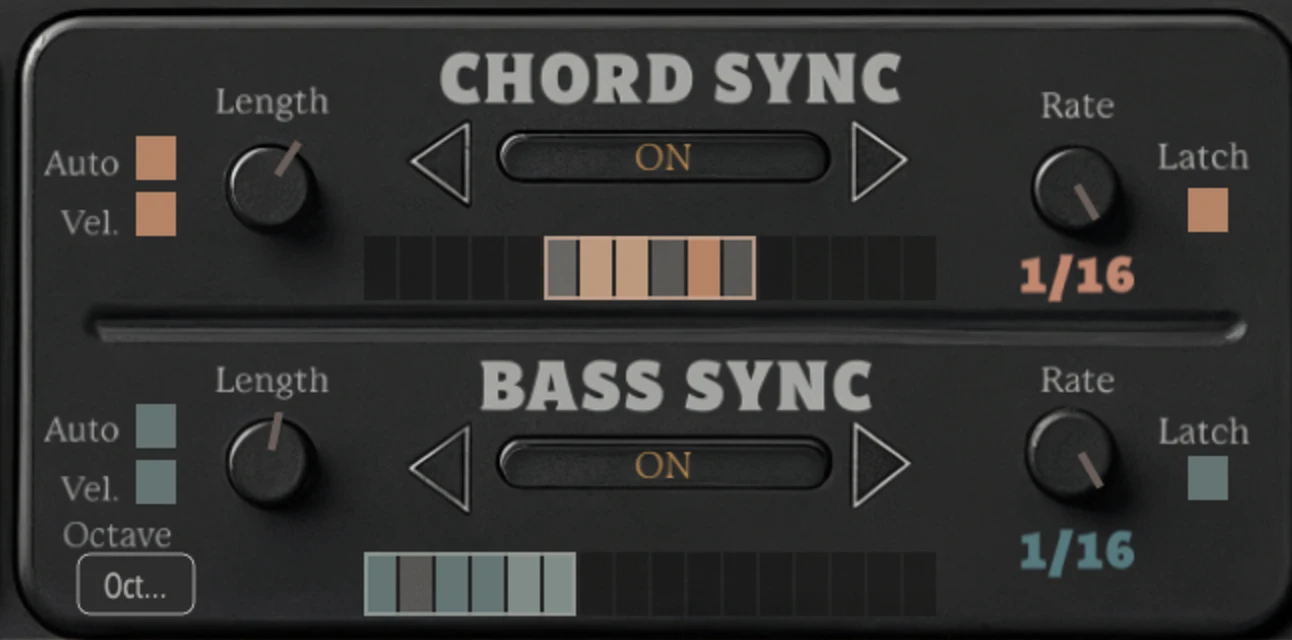
Changing a loop range keeps the steps outside it intact.
Create cross-rhythms with different loop lengths
Let the chord and bass patterns repeat at different lengths while both stay synced to tempo.
Each rate remembers its own grid pattern and loop range, so you can return to a pattern without rebuilding it.
Changing a loop range keeps the steps outside it intact.
Presets
Coordinated chord and bass presets
Hear how the two parts work together, then adjust the patterns and timing to fit your progression.
Auto Bass Octave
Add octave movement to the bass pattern
Let synced bass notes alternate between octaves or follow a repeating octave pattern.
Presets
Coordinated chord and bass presets
Hear how the two parts work together, then adjust the patterns and timing to fit your progression.
Auto Bass Octave
Add octave movement to the bass pattern
Let synced bass notes alternate between octaves or follow a repeating octave pattern.
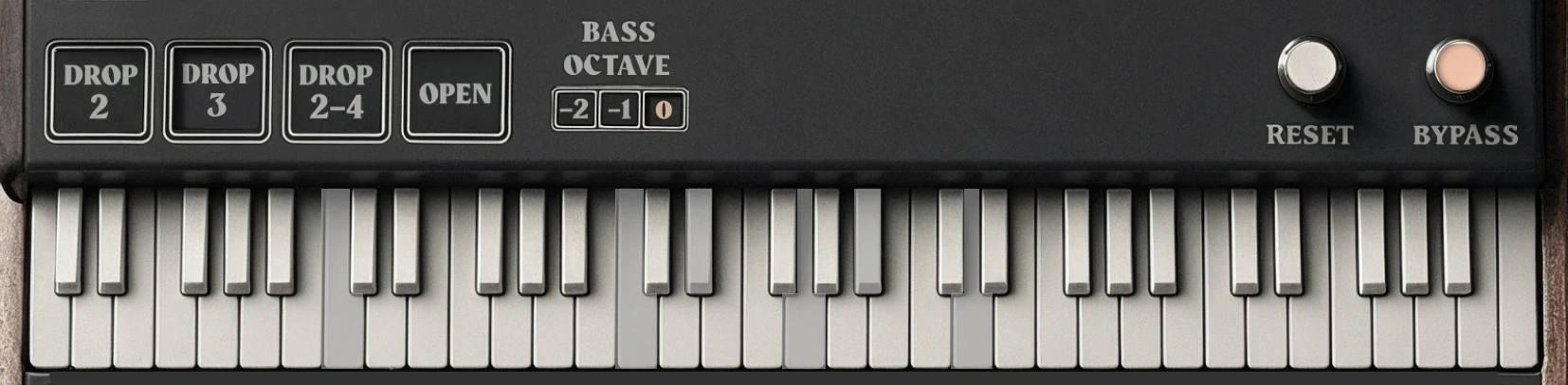
Bypass
Bypass passes MIDI through unchanged, so you can compare the result with your original playing.
Bypass
Bypass passes MIDI through unchanged, so you can compare the result with your original playing.


Before you start
Practical questions
The manual covers setup and the controls in more detail.
Before you start
Practical questions
The manual covers setup and the controls in more detail.
No. Chord Chameleon reshapes chords you play or send from a MIDI clip; it does not build a chord from a single note.
No. Chord Chameleon reshapes chords you play or send from a MIDI clip; it does not build a chord from a single note.
Use your own instrument
Use your own instrument

Your playing
Play live or use MIDI from a track.
Your playing
Play live or use MIDI from a track.

Chord Chameleon
Applies the chord and rhythm settings to your MIDI.
Chord Chameleon
Applies the chord and rhythm settings to your MIDI.

Your instrument
Plays the transformed notes.
Your instrument
Plays the transformed notes.
IN PRACTICE
Remix MIDI clips
IN PRACTICE
Remix MIDI clips
Try new voicings and rhythms without rewriting the notes in your clip.
Try new voicings and rhythms without rewriting the notes in your clip.
01
Vary the inversions in a repeating progression
Auto Invert can give repeated chords different inversions as the clip plays.
02
Perform or automate changes during playback
Map the controls to your MIDI controller, or automate inversion and sync changes in your DAW.
03
Work with unquantized chords
A higher Forgiveness setting allows more timing variation when detecting chords in a clip that is not tightly quantized.
04
Build repeating patterns from short notes
Latch keeps the chord or bass pattern running after short source notes end.
05
Create cross-rhythms from chords and bass
Different chord and bass loop lengths can change where the two parts meet, even when both use the same rate.
06
Adapt a preset to the clip
Start with coordinated chord and bass settings, then adjust Swing, note length, or velocity variation to change how the part plays.
01
Vary the inversions in a repeating progression
Auto Invert can give repeated chords different inversions as the clip plays.
02
Perform or automate changes during playback
Map the controls to your MIDI controller, or automate inversion and sync changes in your DAW.
03
Work with unquantized chords
A higher Forgiveness setting allows more timing variation when detecting chords in a clip that is not tightly quantized.
04
Build repeating patterns from short notes
Latch keeps the chord or bass pattern running after short source notes end.
05
Create cross-rhythms from chords and bass
Different chord and bass loop lengths can change where the two parts meet, even when both use the same rate.
06
Adapt a preset to the clip
Start with coordinated chord and bass settings, then adjust Swing, note length, or velocity variation to change how the part plays.
COMPATIBILITY
System Requirements
Chord Chameleon runs as a MIDI effect in a compatible DAW and controls the instrument you route it to.
COMPATIBILITY
System Requirements
Chord Chameleon runs as a MIDI effect in a compatible DAW and controls the instrument you route it to.
macOS
macOS 11 or later, on Apple silicon or Intel.
Windows
64-bit Windows on an x64 system.
Plug-in formats
VST3 and AU on macOS; VST3 on Windows.
Host requirements
A compatible DAW that can route the plug-in’s MIDI output to an instrument.
Sound source
A MIDI instrument to play the processed notes.
MIDI input
Live MIDI input or existing MIDI clips.
macOS
macOS 11 or later, on Apple silicon or Intel.
Windows
64-bit Windows on an x64 system.
Plug-in formats
VST3 and AU on macOS; VST3 on Windows.
Host requirements
A compatible DAW that can route the plug-in’s MIDI output to an instrument.
Sound source
A MIDI instrument to play the processed notes.
MIDI input
Live MIDI input or existing MIDI clips.
DAW SETUP GUIDES
Quickstart guides for Ableton Live, Logic Pro, and FL Studio are included with your download.
View setup instructions
DAW SETUP GUIDES
Quickstart guides for Ableton Live, Logic Pro, and FL Studio are included with your download.
View setup instructions

USER MANUAL
USER MANUAL
Explore the chord and bass controls.
Explore the chord and bass controls.
The manual explains each control, with examples and notes on playing and MIDI mapping.
The manual explains each control, with examples and notes on playing and MIDI mapping.